Below is an important message from one of our highly valued sponsors. Please read it carefully as they have some special information to share with you.
Dear reader,
Michael Burry is the famous hedge fund manager who predicted the 2008 meltdown…
And made $100 million during that crash.
He’s now putting his own money on the line…
Betting that this AI company I just exposed in this shocking new interview will collapse.
He said:
“This bubble looks an awful lot like the dot-com bubble.” [This company] is doomed and hemorrhaging cash.”
After correctly predicting the last two major stock market meltdowns…
I have to say… I agree 100%.
I believe this company is about to go bust…
In a meltdown that will be 10 times bigger than Lehman Brothers.
So please click here to get the details because…
While most people are in the dark…
Some of the best investors on the planet…
Are already preparing for this coming AI meltdown.
For example, tech billionaire Peter Thiel recently sold his entire stake in Nvidia, worth about $100 million.
The giant investment firm SoftBank also sold all of its Nvidia holdings for $5.8 billion.
Ray Dalio’s hedge fund has also been dumping shares of some of the biggest AI players.
He recently cut his Nvidia position by 65%, Google by 52% and Meta by 48%.
And over the past few months Warren Buffett sold $177 billion worth of stocks…
And he’s now holding a record position in cash.
I highly recommend you avoid these hyped-up AI stocks…
Regards,
Jim Rickards
Chipotle’s Kitchen Machines Are Doing More Than Saving Time
The margin math at Chipotle has been uncomfortable for two straight quarters. Restaurant-level operating margin fell to 23.7% in Q1 2026, down from 26.2% a year earlier, and for the first half of 2026, labor costs climbed to 25.5% of revenue from 24.8%. That creep is not a rounding error. In Q1 alone, labor hit 26.1% of total revenue, up from 25.0% in the prior year, driven by wage inflation, lower average restaurant sales volumes, and higher benefits expense. Chipotle has a cost structure problem concentrated in its busiest hours, and its answer is hardware, not headcount.
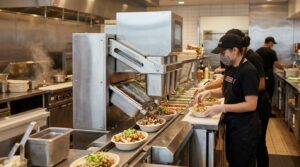
The High-Efficiency Equipment Package, known internally as HEEP, is the engine of that answer. The package includes dual-sided planchas for faster protein cooking, three-pan rice cookers that streamline preparation, and high-capacity fryers that improve chip production during peak periods. Executives have described it as creating “several hours” of efficiency a restaurant can take out each day. That is the kind of compressible labor hour that actually shows up in the cost line.
The rollout is accelerating at a pace that suggests management sees real payback. As of late April 2026, management said the equipment package was in over 600 restaurants and that the company was on track to reach about 2,000 by the end of 2026, with a systemwide rollout targeted for late 2027 or early 2028. The throughput numbers are specific enough to take seriously. Management has said restaurants with the package are seeing better throughput and “meaningful” comparable-sales outperformance, with some commentary pointing to roughly 200 to 400 basis points of lift depending on the restaurant.
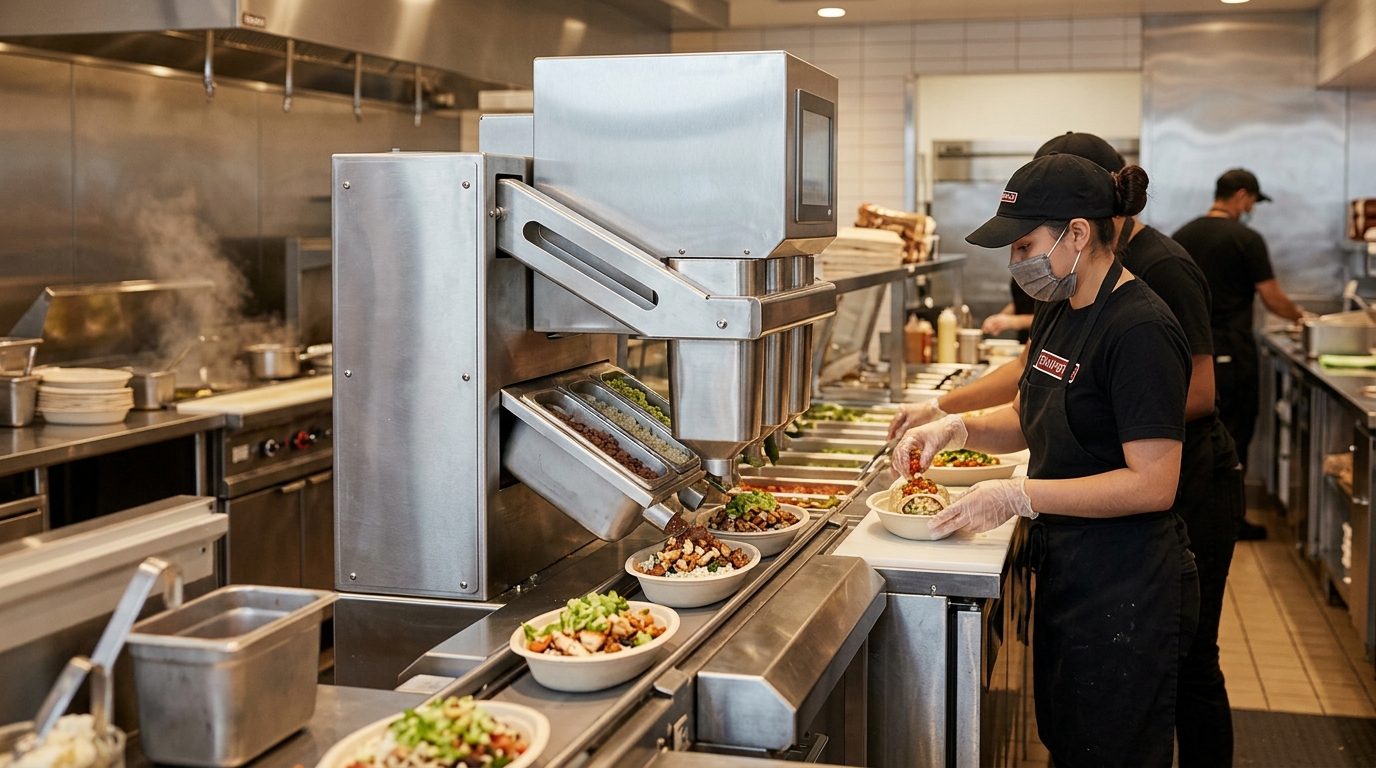
This is where the angle gets interesting. The conventional read on restaurant automation is labor replacement: fewer people, lower costs. Chipotle is doing something narrower and arguably smarter. Rather than thinning crews, it is removing the prep bottlenecks that cause high-volume locations to lose revenue at peak. Chipotle’s automated digital makeline, built with Hyphen, automates bowl and salad assembly for digital orders, and approximately 65% of digital orders are bowls or salads. The machine handles the volume spike; the crew handles hospitality.
The honest counter-argument is that costs are rising faster than the equipment can offset them. In Q2 2026, cost of sales increased roughly 80 basis points, labor costs rose about 30 basis points to 25.0% of sales, and other operating costs climbed roughly 90 basis points to 14.9% of sales. Wage pressure remains a persistent headwind across the industry, and management specifically called out wage inflation and performance-based bonuses as margin pressures in the quarter. Menu price increases are absorbing some of that, but restaurant-level operating margin of 25.2% in Q2 represented a 220-basis-point decline from 27.4% in the prior year period.
What HEEP actually buys Chipotle is optionality. A restaurant that can serve more entrees per 15-minute peak window earns more revenue from the same square footage without adding a single labor hour. At scale across roughly 2,000 locations, that throughput delta becomes a meaningful margin buffer, one that wage legislation cannot directly erode. The machines do not negotiate. Chipotle’s return on equity of about 50% reflects strong underlying profitability, and disciplined long-term investors should weigh whether the HEEP economics can widen that base as the full rollout lands in late 2027 or early 2028. The investment case rests on that answer.