




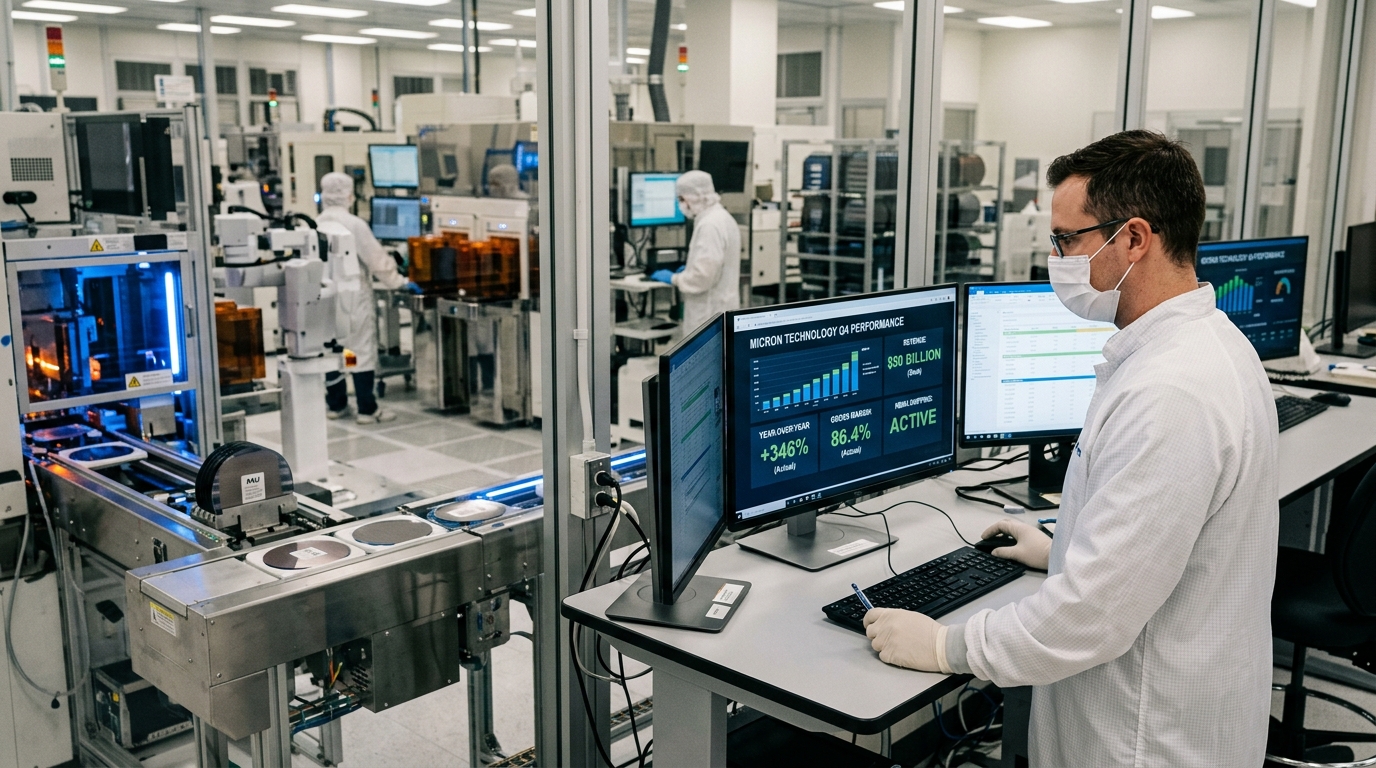
Six days from now, Micron Technology reports its fiscal fourth quarter. The bar is not low: $50 billion in revenue, 86% gross margin, $31 in non-GAAP EPS. What makes this different from most high-expectation earnings events is that management set those numbers themselves in June, and the market has had three months to decide whether to believe them.
So far, it does. Micron shares are up sharply year to date, riding a fiscal 2026 that produced $41.46 billion in Q3 revenue and non-GAAP EPS of $25.11. Those are not predictions. They are reported numbers, filed with the SEC.
Why This Stock Now
The catalyst is September 30, after the bell. Micron has confirmed its fiscal Q4 report for that date, with guidance of $50 billion in revenue plus or minus $1 billion, non-GAAP gross margin of approximately 86%, and non-GAAP EPS of $31 plus or minus $1. That guidance came in at the midpoint $6.55 billion above the Wall Street consensus of $43.45 billion at the time it was issued. A miss now would be a real event. A beat is what the last seven quarters would suggest.
The Business
Micron makes the memory chips that keep AI systems running. High-bandwidth memory, or HBM, sits next to the GPU and feeds it data fast enough to prevent the chip from starving. HBM is stacked DRAM that sits next to AI accelerators. Micron supplies HBM, DDR5, and NAND SSDs into cloud, data center, and edge AI systems.
The supply picture is what makes the business unusual. CEO Sanjay Mehrotra has said that, in the medium term, Micron is only able to meet about 50% to two-thirds of demand from several key customers, a structural supply deficit that continues to amplify pricing power. That is not a marketing claim. It is a manufacturing constraint, and it is why gross margin rose to about 85% in Q3 from 38% a year earlier.
Why Wall Street Is Paying Attention
The Strategic Customer Agreements represent a structural shift, not a commercial deal. Sixteen take-or-pay agreements cover roughly 20% of DRAM volume and one-third of NAND volume through calendar 2030. The minimum contractual revenue totals about $100 billion, and Micron expects to receive $22 billion in customer cash deposits and related financial commitments.
HBM4 is already shipping. Management has also said Micron has already shipped over $1 billion in HBM4 revenue. On the Q3 call, the company discussed demand for HBM3E and HBM4 extending into calendar 2027, but Micron has not formally reported that HBM3E and HBM4 are fully booked through 2027 as a disclosed company figure.
At roughly $1,072, MU trades at a trailing P/E in the mid-20s. Whether the stock is still cheap comes down to whether Micron can deliver on the $50 billion quarter and sustain something close to these margins through the next leg of the cycle.
What Could Go Wrong
The whole thesis rests on hyperscaler capex continuing. The primary risk is a demand air pocket if hyperscaler capex plans slip. If a major cloud provider pauses its data center buildout, memory pricing follows fast. Micron’s margins went from 38% to about 85% in a year. The move works both ways.
Micron has talked about tight supply and very strong demand for HBM into 2027, but the supply-demand picture beyond 2028 remains uncertain. The stock is priced for the boom to last. If it does not, a valuation that looks acceptable today can stop looking like an anchor.
The Bottom Line
Micron reports in six days on guidance it set itself, carrying a valuation that implies either a bargain or a market misreading the cycle. Three things must go right: Q4 earnings must clear the $31 EPS bar, SCA-driven revenue visibility must translate into FY2027 EPS revisions, and HBM4 yields must ramp on schedule. All three are checkable Wednesday evening. That combination of a hard date, contracted demand, and a still-reasonable multiple is the case for owning MU today.