

Hard drives are not glamorous. Never have been. That’s probably why this story isn’t getting the attention it deserves.
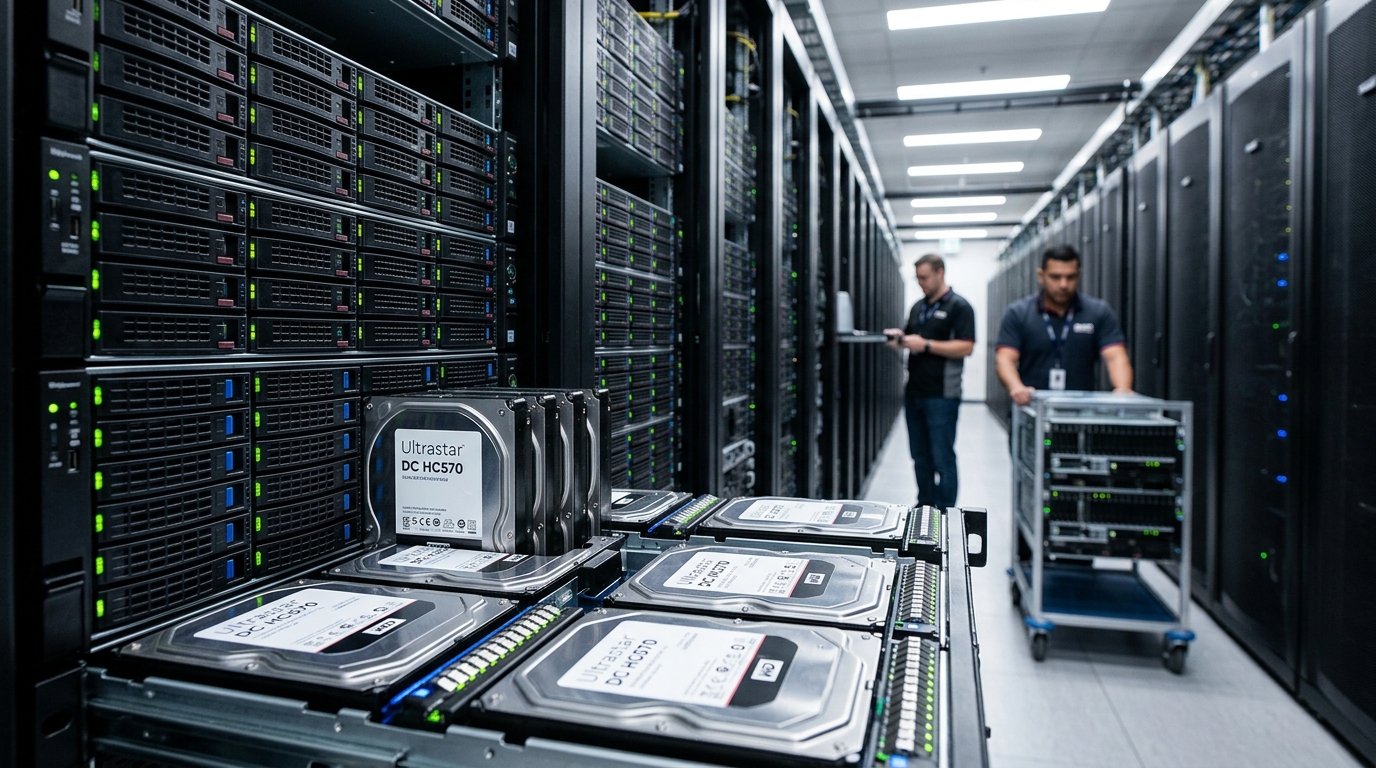
Western Digital has emerged as one of the clearest beneficiaries of the AI infrastructure buildout, with its entire 2026 hard disk drive production capacity now committed to data center customers. The company’s fiscal second-quarter results exceeded the high end of guidance, delivering $3.02 billion in revenue and tripling GAAP profit to $1.84 billion as hyperscale cloud operators scrambled to secure high-capacity storage for AI training and inference workloads.
Let that number settle. Tripled profit. Not grown. Tripled.
Heavy spending on AI infrastructure has supercharged Western Digital stock in 2026, with shares jumping by 170% this year. And yet most investors still think of this company the way they thought about it five years ago – as a slow, cyclical hardware maker that competes on cost and loses to flash storage eventually.
That framing is badly outdated.
Why the AI storage cycle is different this time
With enterprise HDDs remaining roughly seven times cheaper than SSDs for bulk AI-scale storage, Western Digital’s positioning as a pure-play HDD company – following the separation of its SanDisk flash business – has given it concentrated exposure to what analysts are calling a storage supercycle.
As generative AI moves from the training phase to the inference and archival phases, the volume of data that must be stored permanently is growing at a compound annual growth rate of over 40%. That’s not a one-cycle demand spike. That’s a structural shift in how much storage the world needs, and HDDs are still the most cost-effective way to meet it at scale.
Western Digital estimates that the AI and cloud storage market is on track to grow at a compound annual growth rate of more than 25% through 2030. Customers are already placing orders for 2028 to secure enough storage for AI data centers. As a result, the increase in HDD prices appears sustainable, especially given that the shortage could extend into 2030.
What’s interesting is the revenue visibility this creates. The separation allows investors and management to focus on the structural demand story in high-capacity storage, where AI data center buildouts are creating multi-year demand visibility. With 2026 production sold out and contracts extending to 2028, Western Digital has a level of revenue predictability more commonly associated with software subscription businesses.
The earnings trajectory is harder to ignore than the stock price.
Western Digital noted that its earnings could jump past $20.00 per share in the next three to five years. The company has clocked $6.65 in earnings per share in the first nine months of the current fiscal year and expects $3.25 per share in the current quarter, putting it on track to end fiscal 2026 with earnings per share of approximately $9.90.
Analysts are expecting Western Digital’s earnings to cross the $25.00 per share mark over the next couple of years.
There are real risks here. The stock has moved a lot. Western Digital, trading at around $562, is undervalued relative to its future cash flow value of $941. Despite earnings growth forecasted at 17.83% annually, its strategic innovations in AI infrastructure and quantum-resilient storage position it well for future opportunities.
The part people skip: the roadmap. The roadmap targets 50TB drives later in 2026 and 100TB drives by 2029, a trajectory that would continue to widen the cost-per-terabyte advantage HDDs hold over flash-based alternatives. Every time the capacity ceiling rises, the addressable market for high-density storage expands.
The market spent years treating Western Digital like a commodity hardware company. It isn’t that anymore. Whether the stock has already priced the full re-rating is the question worth sitting with. But the business transformation is real, the demand is locked in through at least 2028, and the earnings power that’s coming isn’t built on speculation. It’s already in the order book.
This article is for informational purposes only and does not constitute investment advice. Always conduct your own research before making any investment decisions.