



At the start of 2026, traders were pricing in two rate cuts by December. That consensus is gone.
What replaced it is more complicated – and more dangerous for portfolios positioned around the old playbook.
The Federal Reserve held rates steady at its June 17 meeting, keeping the federal funds rate in the 3.50%–3.75% range. That part was expected. What wasn’t expected – or at least wasn’t priced heading into the meeting – was the degree of hawkish signaling that followed.
New Chair Kevin Warsh used his first press conference to say the committee is “unanimous and unambiguous” in its commitment to fighting inflation, mentioning the phrase “price stability” 12 times in a single session. He also shortened the Fed’s official statement, removed forward guidance entirely, and announced five internal task forces to review Fed communications, balance sheet policy, and the inflation framework. These are not the actions of a chair managing toward cuts. These are the actions of someone resetting institutional posture.
Markets reacted. Two-year Treasury yields climbed 16 basis points. The S&P 500 fell 1.2%. The Russell 2000 dropped 0.8%. And then, over the following sessions, the recalibration continued.
The Data Behind the Shift
The rate story doesn’t start with Warsh. It starts with oil and where it took inflation.
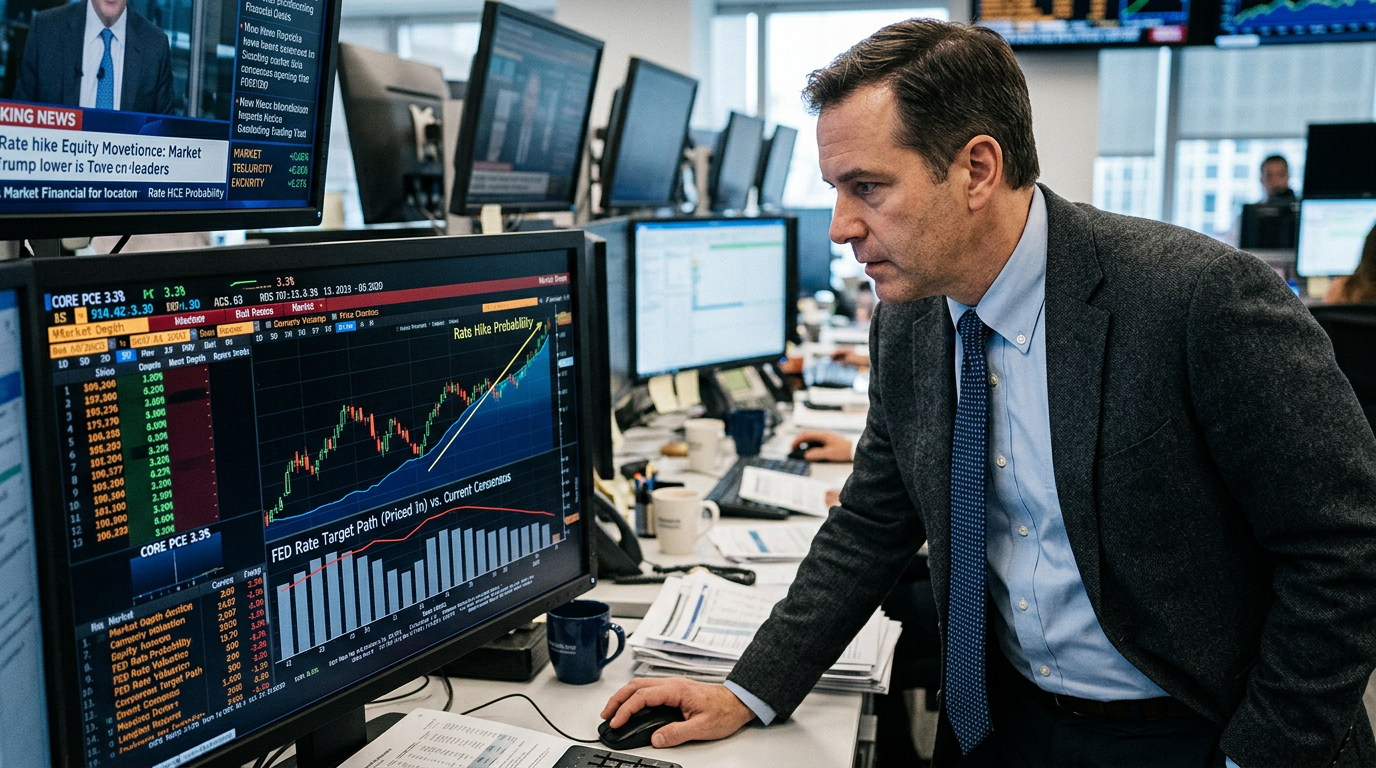
West Texas Intermediate crude peaked near $113 per barrel in April 2026, up from roughly $57 at the start of the year. It has since pulled back to near $76. That correction is real, and it will flow through to headline CPI readings with a lag. But the damage to core inflation has already been done. Core PCE rose from 3.0% in December 2025 to 3.3% in April 2026 – moving in the wrong direction, at the wrong time, with a new chair who has publicly staked his credibility on price stability.
The Fed’s updated Summary of Economic Projections delivered the clearest signal yet. Nine of 18 FOMC officials penciled in at least one rate hike in 2026. Only one projected a cut. The median policymaker is now pointing toward modest tightening by year-end – a complete reversal from March projections that had pointed to rate cuts. Fed funds futures have repriced accordingly: CME FedWatch now shows virtually no probability of cuts in 2026, a stark contrast to where markets were positioned just four months ago.
Slight tangent here, but it matters: this isn’t just a U.S. story. The European Central Bank raised rates by 25 basis points in June, bringing its key rate to 2.25%. The Bank of England held at 3.75% but acknowledged it was “hard to predict” what the Iran war would do to prices. Norway’s central bank signaled a future hike. Australia already moved in March. The synchronized global rate cycle that ran from 2022 to 2024 is potentially starting again – this time from a lower base, with less room for error.
What the Yield Curve Is Actually Saying
The 30-year Treasury yield has pushed above 5%. The 10-year yield now exceeds the S&P 500’s earnings yield by a margin not seen since early 2002 – the tail end of the dot-com bust. That spread matters because it’s a structural argument for owning bonds over equities, and it becomes self-reinforcing when institutional allocators are forced to rebalance.
Historically, when risk-free rates exceed the earnings yield of the equity market for a sustained period, the equity market either reprices lower or earnings have to grow fast enough to close the gap. Right now, equities are betting on the latter. The bond market is betting on the former. One of them is wrong.
The yield curve has also steepened, with long-term rates rising faster than short-term rates. That’s unusual in a potential hiking cycle and suggests markets are pricing in both near-term inflation risk and an eventual policy overshoot that slows the economy. The 10-year breakeven inflation rate – the spread between nominal and inflation-protected Treasuries – has climbed to levels that suggest markets are losing confidence in the Fed’s ability to hold price stability on schedule.
Sector Implications: Who Benefits, Who Doesn’t
This repricing has clear winners and losers that most portfolios haven’t fully adjusted to yet.
Financials are the structural beneficiary. Banks and insurers typically benefit from rising rates through improved net interest margins and better returns on fixed income portfolios. JPMorgan, Bank of America, and Wells Fargo all stand to see NIM expansion if the Fed hikes. Insurance companies with large bond portfolios – Berkshire Hathaway (BRK.B), MetLife (MET), Prudential (PRU) – benefit from reinvesting maturing paper at higher yields. Within the sector, regional banks with asset-sensitive balance sheets outperform their liability-sensitive peers in a hiking environment.
Growth stocks face a structural headwind. The repricing of risk-free rates directly raises the discount rate applied to future cash flows. Companies whose valuations depend on earnings 5–7 years out are more affected than near-term earners. Software and high-multiple tech names – already having rebounded sharply off their April lows – are the most exposed to a sustained yield move higher. The iShares Expanded Tech-Software Sector ETF (IGV) recovered to positive territory for the year in early June; that recovery gets tested if 10-year yields push meaningfully above 4.75%.
Real estate and utilities face renewed pressure. REITs and utility stocks became more attractive during the rate-cut anticipation cycle earlier in the year. Both groups are now competing with Treasuries offering 5%+ at the long end with essentially no credit risk. XLRE and XLU have been in the lagging quadrant of relative sector momentum, and that’s unlikely to reverse without a clear pivot in Fed communication.
Energy and materials are the inflation hedges in play. If inflation stays sticky – and the structural case for that is energy prices, supply chain fragmentation, and wage pressure from a labor market adding 117,000 private jobs per month – then real assets outperform financial assets over the medium term. That’s the same logic that has driven energy stocks up more than 22% year-to-date in 2026.
The Earnings Risk Most Analysts Are Underweighting
Here’s what’s being missed.
Q1 2026 S&P 500 earnings grew 28.6%, crushing expectations. FactSet’s blended net profit margin hit 14.8%, a record. That’s the backdrop equity bulls are anchoring to. But that earnings strength was delivered in a world where markets were still pricing rate cuts. Corporate borrowing costs, refinancing assumptions, and capital allocation decisions were all made under a different rate regime.
If the Fed hikes once or twice before year-end, the forward earnings estimates embedded in current valuations need to come down. Companies with heavy floating-rate debt exposure will see interest expense creep higher. Consumer-facing businesses will face a customer base with less discretionary income as mortgage payments, auto loans, and credit card rates follow the Fed higher. The consumer is already showing signs of stress – travel companies have reported trading down from international to domestic options, and savings rates have been declining.
The earnings risk isn’t in 2026. It’s in 2027 guidance, and it’s not in the current consensus.
Scenario Modeling
Bull Case: Oil continues to fall as the Iran-U.S. memorandum of understanding holds. Brent crude drops toward $70 by Q3. Core PCE retreats toward 2.8% by October. Warsh signals patience, rate hike fears fade, and the yield curve flattens. Equities re-rate higher on renewed cut expectations, with growth stocks leading. The S&P 500 retests the 5,800 level before year-end. Financials give back some of their rate-anticipation gains.
Base Case: The Fed stays on hold through Q3 and delivers one 25-basis-point hike in Q4. Core PCE moderates gradually but stays above 3.0%. The yield curve remains steep, financials continue to outperform, and growth stocks consolidate the gains made since the April lows. The S&P 500 ends the year roughly flat to up 3–5% from current levels. Sector leadership stays with energy, financials, and materials.
Bear Case: Core inflation re-accelerates as second-round energy effects work through wages. The Fed hikes twice – in September and December – by 25 basis points each. The 10-year Treasury yield breaks above 5%. Earnings guidance cuts accelerate in Q3 as higher financing costs and weaker consumer demand compress margins. The S&P 500 tests the April lows. The most rate-sensitive sectors – REITs, utilities, high-multiple software – fall 15–25% from current levels. Credit spreads widen, pressuring high-yield issuers. This scenario requires two conditions: oil doesn’t fall further, and the labor market stays strong enough to give the Fed political cover to move.
Active Trader Strategy Framework
The clearest trade in this environment is the rotation that is already underway but not yet complete. Energy, materials, and financials are outperforming. That leadership continues in the base and bear cases. The mistake is assuming the rotation is over because it’s been running for months. Sector rotations in late-cycle environments typically last 18–24 months, not 6.
For rates positioning, the belly of the curve – 3-to-7-year Treasuries – offers the best risk-reward if you believe the Fed hikes once and pauses. Short-term yields have already moved most of the way to pricing a hike. Long-term yields have moved less, which means there’s still room for steepening. Investors comfortable with duration risk who believe inflation peaks in H2 2026 should consider intermediate Treasuries over long-duration bonds right now.
On individual equity names, the rate hike environment creates a clear screening framework. Look for companies with: (1) fixed-rate debt structures, (2) pricing power that allows margin preservation under inflationary conditions, (3) near-term earnings that aren’t dependent on future-year discounting, and (4) balance sheets strong enough to take advantage of stressed competitors. That screen favors large-cap industrials, integrated energy companies, and well-capitalized regional banks.
Watch the 2-year Treasury yield as the primary rate hike signal. Above 4.25%, the market is pricing a hike as more likely than not. Below 3.90%, the hike fear is fading. The current range of roughly 4.10%–4.20% says: the market is nervous, but not yet committed. That ambiguity is where the opportunity lives for traders willing to take a view.
The part most portfolios are missing right now is simple: the last two years of positioning was built around rate cuts. The rate cuts didn’t come. The cuts were replaced by a hold. The hold is being replaced by a hike discussion. Each step in that sequence has been underpriced by equities relative to fixed income. The bond market has been right. Equities have been looking the other way. That divergence closes eventually – either through earnings growth or through price.
Right now, earnings growth alone can’t close a gap this wide.
For informational and educational purposes only. Not investment advice. Trading involves risk, including loss of principal.