



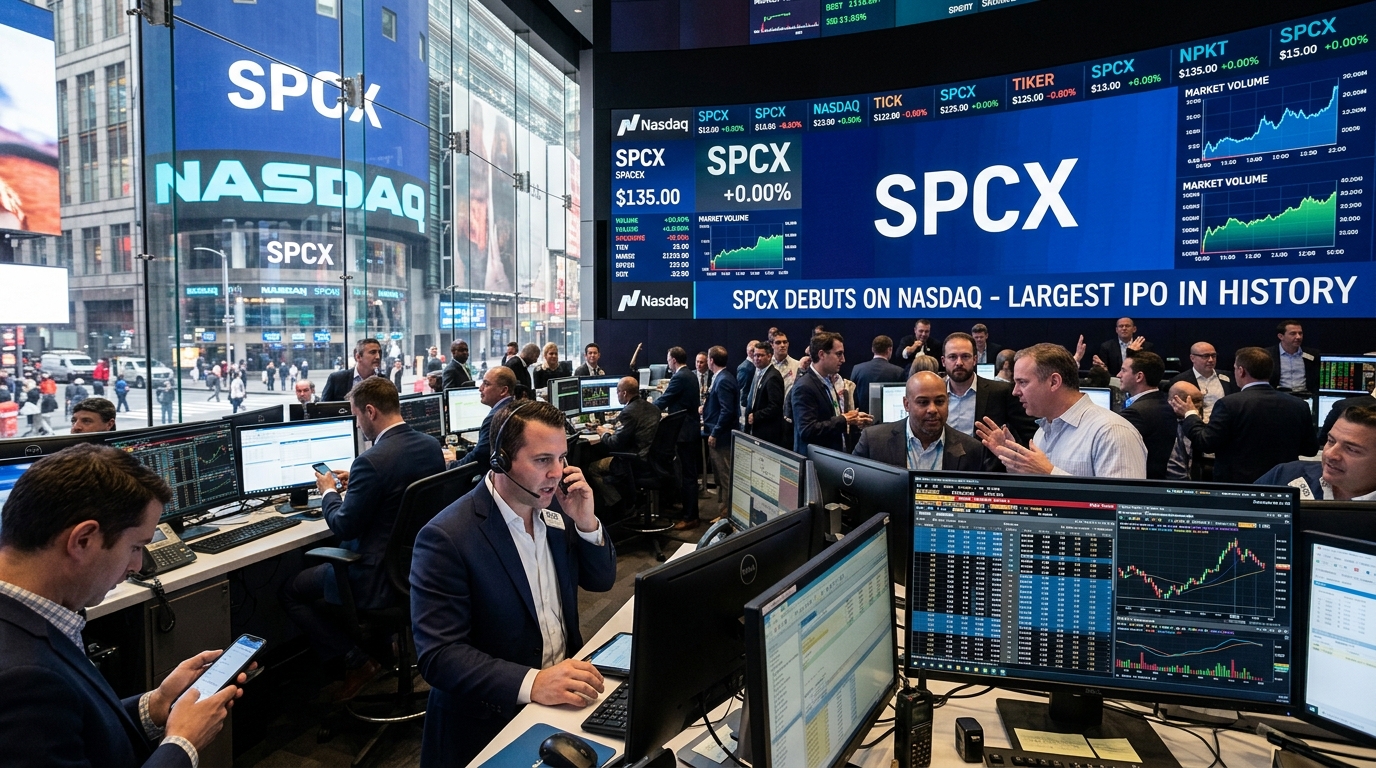
Today is the day. SpaceX — Elon Musk’s rocket, satellite, and AI conglomerate — begins trading on the Nasdaq under the ticker SPCX at a fixed price of $135 per share. The company raised $75 billion in what is formally the largest initial public offering in stock market history, surpassing Saudi Aramco’s 2019 record by more than double.
Slight tangent, but it matters: the deal attracted more than $250 billion in investor demand — roughly 3.5 to 4 times the $75 billion being raised. That’s not a supply/demand mismatch. That’s a structural event.
What You’re Actually Buying at $135
At the IPO price, SpaceX is valued at approximately $1.75 trillion. That puts it above Tesla in market cap and makes it the seventh-largest company in the U.S. on day one. The revenue multiple is somewhere between 109x and 116x 2025 trailing revenue — a figure normally reserved for early-stage SaaS, not a capital-intensive launch business that posted a $4.28 billion net loss in Q1 2026 alone.
The bull case is Starlink. The satellite internet unit posted a $1.19 billion operating profit in Q1 2026 and now serves approximately 10.3 million subscribers. Starlink represented roughly 58% of SpaceX’s total revenue in 2024. That’s the profit engine. Everything else — Starship development, the xAI Colossus data center, launch services — is still burning cash.
Morningstar put their weighted fair value estimate at $63 per share, a 53% discount to the offering price. Their most optimistic scenario — which assumes a rapidly reusable Starship and commercially scaled orbital data centers — arrives at $154 per share and carries a 7% probability. What that tells you is that at $135, the market is essentially paying full price for the moonshot scenario and getting the core business as a bonus. Whether that’s rational depends entirely on your time horizon.
The Market Structure Problem — and the Options Angle
Here’s what makes this different from any IPO you’ve traded before. Options on SPCX are expected to list quickly after the stock’s debut, and from day one, traders should expect heavy derivatives activity. The IPO structure itself introduces structural volatility layers that are worth mapping out.
First: the friends-and-family carve-out means up to $3.75 billion in unlocked stock could theoretically be sold on day one. That’s a real overhang. Second: Nasdaq-100 inclusion is expected around early July, which means passive index funds — tracking billions in 401k and retirement assets — will be forced to buy SPCX regardless of price to match their benchmarks. That’s a structural buying event independent of any view on fundamentals. Third: the first insider selling window opens after SpaceX’s first earnings report as a public company, expected in late July or early August.
What this creates is a multi-layered event calendar — debut volatility, index inclusion flows, and then the first earnings print — all compressed into a roughly 8-week window. For options traders, that’s a calendar spread setup worth studying closely once contracts list.
The Broader Market Disruption Risk
This is the part most traders aren’t pricing carefully enough. The SpaceX IPO — along with expected mega-IPOs from Anthropic and OpenAI later this year — could trigger meaningful selling flows across existing listed equities as investors raise cash to fund allocations. One BNP Paribas strategist described retail behavior this year as ‘FOMO-style, rally-chasing,’ and warned that ‘selling flows in recent winners and levered products from retail to invest in SpaceX could be very large.’
The Nasdaq shed more than 7% between June 1 and this week’s lows. That’s not a coincidence. Capital rotation ahead of the largest IPO in history has real secondary effects across the portfolio.
Defined-Risk Framework for SPCX Day One
- Bull structure: For traders expecting a first-day pop above $135, a long call spread in the $140–$155 range (once options list) expresses upside with defined risk. Watch the first-hour volume and bid-ask spread before sizing.
- Bear/neutral structure: Given the $14 billion net debt position and $20 billion bridge loan maturing 15 months post-IPO, a put spread or collar structure hedges against a Cerebras-style pop-then-fade scenario.
- Calendar/volatility play: Straddle or strangle structures with July expiration capture both the index inclusion flows and first earnings print in a single defined-risk trade.
Key Numbers: IPO price $135 | Valuation $1.75T | Capital raised $75B | Q1 2026 net loss $4.28B | Starlink Q1 operating profit $1.19B | Subscriber base 10.3M | Musk voting control post-IPO: 82%+
The deeper question isn’t whether SPCX opens above or below $135 today. It’s whether the stock is still at $135 — or anywhere near it — when Starship Flight 12 launches and when the first public earnings report lands in August. That’s when the narrative meets the math, and the options market will be priced accordingly by then.