By Ann Saphir
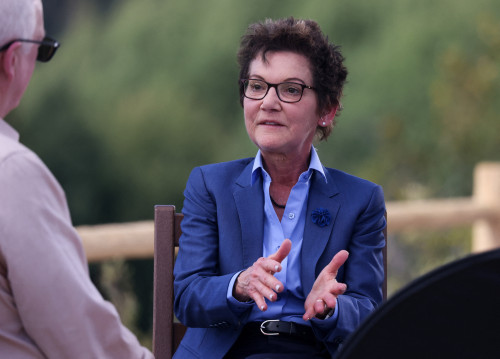
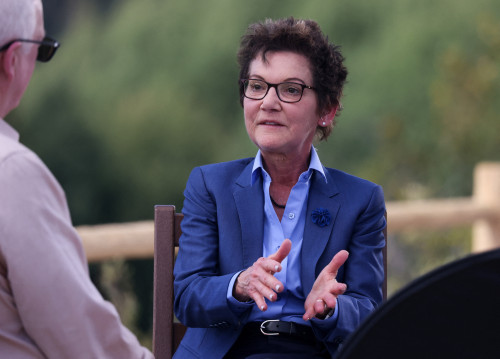
Feb 6 (Reuters) – San Francisco Federal Reserve Bank President Mary Daly said on Friday she thinks the U.S. labor market is in a “precarious” position, saying there could have been a case for the Fed to cut rates last week and that further interest-rate cuts may be needed.
While businesses are largely cautiously optimistic, she said, households are less confident, given that businesses so far hesitant to make mass layoffs could rapidly switch gears.
“We’ve been in a relatively low-hiring, low-firing environment for some time. That may persist, but workers are aware that things could change quickly, leaving them in a no-hiring, more-firing labor market,” Daly said in a post on LinkedIn. “With inflation printing above the FOMC’s 2 percent goal, this rightly feels precarious.”
Speaking later with Reuters, she said that “given what I’m seeing in the economy, I lean towards, you know, additional cuts. Whether that’s one or two is hard to say.”
VICE CHAIR SEES POTENTIAL FOR WEAKER JOB MARKET
Speaking at a separate event, Fed Vice Chair Philip Jefferson also flagged the potential for a suddenly weaker job market, though he thinks the job market is stable and supported by the Fed’s rate cuts to date. “Things can change in the labor market quickly,” he said. “We don’t need to see any more weakening in the labor market. I would not want that.”
The U.S. Federal Reserve last week left short-term borrowing costs on hold, citing too-high inflation and a labor market that appeared to be stabilizing. Fed Chair Jerome Powell said the central bank was “well positioned” to respond, “letting the data light the way for us.”
Other policymakers since then have suggested they lean in one direction or another, with Fed Governor Lisa Cook on Wednesday saying she feels the risks are “tilted toward higher inflation,” while Fed Vice Chair for Supervision Michelle Bowman noted shortly after she joined Cook in the 10-2 vote to leave rates in their 3.50% to 3.75% range that she did not “consider downside risks to the employment side of our mandate to have diminished.”
Most estimates, including from Fed policymakers, put underlying inflation at the end of last year at around 3%, above the Fed’s 2% goal. Data on the labor market has mostly convinced economists that the low-hiring, low-firing stasis continues.
The Bureau of Labor Statistics releases the monthly jobs report next Wednesday. It was delayed by the government shutdown over a standoff between Democrats and Republicans on funding for immigration enforcement that continues to simmer, and economists expect it to show the unemployment rate was steady in January at 4.4%.
But a five-year low in job openings in December and a rise in new weekly claims for unemployment insurance reported on Thursday by the U.S. Labor Department have some analysts beginning to worry the balance may be breaking toward labor market weakness.
“The large downside surprise in December job openings may concern Fed officials and suggest they were premature to remove language in last month’s policy statement emphasising elevated downside risks to the labour market,” wrote analyst Thomas Ryan at Capital Economics. “That said, with the hiring rate ticking up and the layoff rate remaining very low, we would not jump to the conclusion that the jobs market took another leg lower at the end of last year.”
For Daly, the answer appears to be standing ready.
“We must watch both sides of our mandate,” Daly said, referring to the Fed’s dual goals of maximum employment amid low inflation. “Americans deserve both price stability and full employment, and we can’t take either for granted.”
(Reporting by Ann Saphir, Howard Schneider; Editing by Chizu Nomiyama, Rod Nickel)